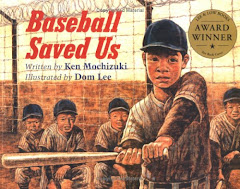
A. Baseball Saved Us
B. Ken Mochizuki
C. Dom Lee
D. Lee and Low Books Inc., 1993
E. picture book, historical fiction
F. 1-4
G. This book is about a young Japanese boy living in a relocation camp during World War II. He starts by talking about how he was bad at baseball outside of the camp and how all the other boys made fun of him. However, in order to pass the time and to keep the kids occupied, the boy's father decides to build a baseball field. The boy plays baseball and becomes very good at it while in the camp. When the Japanese are finally released, he goes back to playing baseball at school. A comment from a person in the stands makes him mad and he hits a homerun, winning the game for his team and thus proving to himself and his teammates that he is a good player and a good person.
H. I love the language used in this book. It's very easy to follow and it seems as though a real boy could have written it and that way, I think it will be a lot easier for young readers to get involved with the book. I also like how the descriptions were very straightforward and not sugarcoated. It made me feel as though Mochizuki wanted to relay the facts without eliciting a whole lot of sympathy; he simply wanted to state the facts. It was also good to see that this book and Weedflower reinforced each other in terms of the descriptions of the camps. That proves to me as an educator that both books contain valuable historical material and are not just meaningful stories.
It amazes me that with both Weedflower and Baseball Saved Us, the authors strove to show how the Japanese overcame their situations. Sumiko had her flowers and the boy had baseball. I just can't believe how resourceful and upbeat these people were even after everything they'd gone through. I know that if I had been forcefully relocated for no good reason, I doubt I would have been able to find something to be happy about. But these books provide a great lesson that you must play the hand you are dealt.
The illustrations were also very interesting to me. I have never before seen any art done with beeswax (at least as far as I know). I thought that was an interesting medium to use. Each picture has so much texture in it that I wish it weren't a print. I want to touch it! Also, all the pictures are monochromatic until the last two pages where the boy hits the homerun. This is a good indication of the blandness of camp life. And perhaps also a good indication of the dusty, arid climate. I also liked that the ending of the story was not told in text, it was told through the illustrations.
I. Baseball Saved Us provides many great lessons. The most obvious one is that this book is a great introduction into forced relocation and the plight of Japanese-Americans in WWII. I wouldn't use this book with older readers simply because the content of the book is a little too elementary for children who have already been exposed to this theme. With younger elementary students, I would lead a discussion about a time when they had seen something that was unfair and what they did about it or what they would do differently if it happened again. Also, this book provides a lesson on how to deal with things in life when life isn't exactly going the way we planned or hoped. It's a fact that bad things happen to good people but the best people can turn those bad things into at least a better thing (if not a good thing). I would ask students to think of a time when something happened that made them mad or upset. Then we would talk about ways that they could have made the situation better or ways that they did make the situation better. I would also ask kids to try to imagine how it would feel for this to happen to them and how they would react.
*Multicultural*
Tuesday, February 26, 2008

Friday, February 22, 2008
Poem in Response to Aleutian Sparrow
The Aleutians were denied life and liberty.
How could a country founded on these principles
be so blind?
The Aleutians were treated like animals because they looked Japanese.
How could a country so diverse
be so ignorant?
The Aleutians rebuilt their life, given nothing.
How could a culture destroyed without reason
be so ambitious?
How could a country founded on these principles
be so blind?
The Aleutians were treated like animals because they looked Japanese.
How could a country so diverse
be so ignorant?
The Aleutians rebuilt their life, given nothing.
How could a culture destroyed without reason
be so ambitious?
Wednesday, February 20, 2008
Zathura Reader Response
A. Zathura
B. Chris Van Allsburg
C. Chris Van Allsburg
D. Houghton Mifflin Books, 2002
E. picture book, fantasy
F. 2-4
G. Zathura is a story very similar to Jumanji in which two brothers play a game that sends them on a trip into outer space. During the game they encounter robots and space pirates and meteor showers. As the game continues and the brothers must make it through each turn together, Walter begins to see the value of his younger brother. Finally the two make it back home (after having traveled three hours back in time) where Walter tells Danny that he doesn't want to play Zathura when Danny finds the game in the yard. Walter suggests instead that they play catch.
H. To be honest, I wasn't terribly fond of this book. I wasn't fond of Jumanji and I guess the feelings carried over. To be sure, I like the idea of a space adventure a whole lot better than the animals and jungle-things that took over in Jumanji but I just couldn't really get into either story. A lot of that I think had to do with the fact that the movie scared me to death when I saw it for the first time when I was younger. However, the predicaments that the characters found themselves in were really imaginative. I found it quite comical when Danny's gravity was increased and he turned into a little ball much like Violet Beauregard after eating the blueberry something-or-other in Willy Wonka and the Chocolate Factory. When he asked Walter to roll him across the floor so he could take out the robot, I laughed out loud. What a smart kid!
I love the story within a story about how Walter changing his perspective of his younger brother, Danny. That part of the story is definitely something that all children with siblings can relate to. I know there were times when I wished my younger brother would move to Russia so he wouldn't get in my way or break my toys any more.
I also really liked the illustrations. There is something about Chris Van Allsburgs illustrations that really appeals to me. I love the simplicity of the pencil and the detail he adds into every spread. The shading is so fantastic; it would be easy to overlook the fact that this story is in black and white.
I. This story is a great representation of a sibling relationship. Anyone who has a brother or sister can relate to how both Danny and Walter feel at various times in the story. The book carries a great lesson on how valuable siblings can be and how important it is to treat them with love and kindness. I think children would really relate to this book and enjoy it because the lesson isn't one to be noticed easily. It would great to lead a discussion with the students after reading the book about a time when they have felt as Walter did in the beginning. And then help them to realize all the reasons they love their brothers and/or sisters.
B. Chris Van Allsburg
C. Chris Van Allsburg
D. Houghton Mifflin Books, 2002
E. picture book, fantasy
F. 2-4
G. Zathura is a story very similar to Jumanji in which two brothers play a game that sends them on a trip into outer space. During the game they encounter robots and space pirates and meteor showers. As the game continues and the brothers must make it through each turn together, Walter begins to see the value of his younger brother. Finally the two make it back home (after having traveled three hours back in time) where Walter tells Danny that he doesn't want to play Zathura when Danny finds the game in the yard. Walter suggests instead that they play catch.
H. To be honest, I wasn't terribly fond of this book. I wasn't fond of Jumanji and I guess the feelings carried over. To be sure, I like the idea of a space adventure a whole lot better than the animals and jungle-things that took over in Jumanji but I just couldn't really get into either story. A lot of that I think had to do with the fact that the movie scared me to death when I saw it for the first time when I was younger. However, the predicaments that the characters found themselves in were really imaginative. I found it quite comical when Danny's gravity was increased and he turned into a little ball much like Violet Beauregard after eating the blueberry something-or-other in Willy Wonka and the Chocolate Factory. When he asked Walter to roll him across the floor so he could take out the robot, I laughed out loud. What a smart kid!
I love the story within a story about how Walter changing his perspective of his younger brother, Danny. That part of the story is definitely something that all children with siblings can relate to. I know there were times when I wished my younger brother would move to Russia so he wouldn't get in my way or break my toys any more.
I also really liked the illustrations. There is something about Chris Van Allsburgs illustrations that really appeals to me. I love the simplicity of the pencil and the detail he adds into every spread. The shading is so fantastic; it would be easy to overlook the fact that this story is in black and white.
I. This story is a great representation of a sibling relationship. Anyone who has a brother or sister can relate to how both Danny and Walter feel at various times in the story. The book carries a great lesson on how valuable siblings can be and how important it is to treat them with love and kindness. I think children would really relate to this book and enjoy it because the lesson isn't one to be noticed easily. It would great to lead a discussion with the students after reading the book about a time when they have felt as Walter did in the beginning. And then help them to realize all the reasons they love their brothers and/or sisters.
The Polar Express Reader Response
A. The Polar Express
B. Chris Van Allsburg
C. Chris Van Allsburg
D. Houghton Mifflin Company, 1985
E. Picture book, fiction
F. 2-5
G. The Polar Express is a beautiful story about Christmas spirit. It's the tale of a young boy who in the beginning is not sure whether or not Santa exists. Then one Christmas Eve, a train pulls into his front yard that carries him to the North Pole. There, he meets Santa who gives him a bell off of his sleigh. Unfortunately, the bell falls through the boy's pocket because there is a hole. On Christmas morning, the boy finds a small box with the bell inside. Even after many years, the bell still rings for him because he has not lost his faith in Santa.
H. One can't help but love The Polar Express. There's always something so magical about stories involving holidays, especially Christmas. I've also seen the movie but even though there are so many more levels to the movie, I like the book better. The imagery Van Allsburg uses is so beautiful and it allows the reader to form their own world in their mind. I love the words he uses to describe everything from the "apron of steam" that shrouded the train to the hot chocolate that was "as thick and rich as melted chocolate bars."
One thing that really stood out to me as I was reading and looking at the illustrations is how similar the book is to the movie in terms of illustrations. In the train (in the book), I can see many of the characters from the movie sitting in the seats. I'm really glad to see that the animators for the movie paid that much attention to detail to try to get everything right, down to the colors of the kids' pajamas. The similarities are remarkable!!
However, my favorite favorite favorite part is the last page. Those last three sentences are so eloquent and state so beautifully the faith that one has to have in something. How much happiness it can bring to a person to believe in something that others have long forgotten.
I. This is a great Christmas-time story for any classroom. I would even read it in upper grades.
The major lesson in this story is the lesson of faith and believing in something. The great thing about this is that it can be applied to anything. That bell can represent anything of importance. It would be great to talk to kids about their own beliefs about Santa Claus and then lead that into beliefs about other things. You could lead a discussion about beliefs that students have that perhaps others don't share and why those beliefs are important to those students.
*Caldecott Medal Winner*
B. Chris Van Allsburg
C. Chris Van Allsburg
D. Houghton Mifflin Company, 1985
E. Picture book, fiction
F. 2-5
G. The Polar Express is a beautiful story about Christmas spirit. It's the tale of a young boy who in the beginning is not sure whether or not Santa exists. Then one Christmas Eve, a train pulls into his front yard that carries him to the North Pole. There, he meets Santa who gives him a bell off of his sleigh. Unfortunately, the bell falls through the boy's pocket because there is a hole. On Christmas morning, the boy finds a small box with the bell inside. Even after many years, the bell still rings for him because he has not lost his faith in Santa.
H. One can't help but love The Polar Express. There's always something so magical about stories involving holidays, especially Christmas. I've also seen the movie but even though there are so many more levels to the movie, I like the book better. The imagery Van Allsburg uses is so beautiful and it allows the reader to form their own world in their mind. I love the words he uses to describe everything from the "apron of steam" that shrouded the train to the hot chocolate that was "as thick and rich as melted chocolate bars."
One thing that really stood out to me as I was reading and looking at the illustrations is how similar the book is to the movie in terms of illustrations. In the train (in the book), I can see many of the characters from the movie sitting in the seats. I'm really glad to see that the animators for the movie paid that much attention to detail to try to get everything right, down to the colors of the kids' pajamas. The similarities are remarkable!!
However, my favorite favorite favorite part is the last page. Those last three sentences are so eloquent and state so beautifully the faith that one has to have in something. How much happiness it can bring to a person to believe in something that others have long forgotten.
I. This is a great Christmas-time story for any classroom. I would even read it in upper grades.
The major lesson in this story is the lesson of faith and believing in something. The great thing about this is that it can be applied to anything. That bell can represent anything of importance. It would be great to talk to kids about their own beliefs about Santa Claus and then lead that into beliefs about other things. You could lead a discussion about beliefs that students have that perhaps others don't share and why those beliefs are important to those students.
*Caldecott Medal Winner*
Two Bad Ants Reader Response
A. Two Bad Ants
B. Chris Van Allsburg
C. Chris Van Allsburg
D. Houghton Mifflin Company, 1988
E. Picture book, animal fantasy
F. 1-3
G. This books tells the tale of two bad ants (from the ants' perspective) who go along with the ant colony to investigate the discovery of amazing new crystals that can be eaten. When they get into the cave filled with the crystals, they decide that they aren't going to return home with the rest of the ants. However, as the household awakes, the ants have to survive coffee, a water spigot, and a garbage disposal. After surviving all this, the ants decide that the next night they will return home with the colony.
H. Once again, Chris Van Allsburg has amazed me. What a fantastic tale of a story told from the perspective of ants. The description of everyday things like coffee and water coming out of a faucet is incredible. It must have taken a lot of imagination to think of how these things would seem to an ant. The illustrations were key in the comprehension of the point of view. One picture shows the ants in the coffee as the cup is being tipped towards an open mouth. I know if I were one of those ants, I would be scared!!! It shows how neat it is to look at things from different perspectives.
I. What a great book for teaching perspective! It's not everyday that you run across a book that is written so expertly from the perspective of an ant. It's also a great way to talk about how to see issues from more than one perspective. Seeing both sides of an issue is an important lesson for youngsters.
Lesson Plan from Scholastic
B. Chris Van Allsburg
C. Chris Van Allsburg
D. Houghton Mifflin Company, 1988
E. Picture book, animal fantasy
F. 1-3
G. This books tells the tale of two bad ants (from the ants' perspective) who go along with the ant colony to investigate the discovery of amazing new crystals that can be eaten. When they get into the cave filled with the crystals, they decide that they aren't going to return home with the rest of the ants. However, as the household awakes, the ants have to survive coffee, a water spigot, and a garbage disposal. After surviving all this, the ants decide that the next night they will return home with the colony.
H. Once again, Chris Van Allsburg has amazed me. What a fantastic tale of a story told from the perspective of ants. The description of everyday things like coffee and water coming out of a faucet is incredible. It must have taken a lot of imagination to think of how these things would seem to an ant. The illustrations were key in the comprehension of the point of view. One picture shows the ants in the coffee as the cup is being tipped towards an open mouth. I know if I were one of those ants, I would be scared!!! It shows how neat it is to look at things from different perspectives.
I. What a great book for teaching perspective! It's not everyday that you run across a book that is written so expertly from the perspective of an ant. It's also a great way to talk about how to see issues from more than one perspective. Seeing both sides of an issue is an important lesson for youngsters.
Lesson Plan from Scholastic
The Widow's Broom Reader Response
A. The Widow's Broom
B. Chris Van Allsburg
C. Chris Van Allsburg
D. Houghton Mifflin Company, 1992
E. Picture book, fantasy
F. 2-4
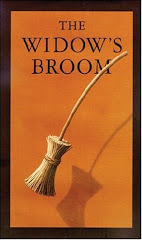
G. This book is about a widow who finds a witch who has fallen due to a faulty broom. Once the witch has healed, she flies away but she leaves her old broom behind. The broom begins to do things around the house, doing whatever the widow teaches it to do. However, when some boys begin taunting the broom, it gets in trouble for throwing their dog really far into the air and hitting the boys. Her neighbors tell her to get rid of the broom and she tricks them into burning a different broom when they decide they will burn it to get rid of it. The widow then paints the real broom white and sends it around the neighbor's house. They get scared and leave town.
H. Chris Van Allsburg amazes me more and more with each book that I read. His plots are unpredictable and very imaginative. I love that the widow hid the broom so that it didn't get destroyed and then painted it white to scare off her neighbors. I thought it was hilarious that the widow's neighbors got so scared of the ghost of the broom (I laughed pretty hard when they decided to leave town because they deserved everything they got because of the way they treated the poor broom!). The illustrations are beautifully drawn in pencil. Just like Bad Day at Riverbend, the illustrations help the text just as the text helps the illustrations. They are integrated as one just as they should be. This book is really quite unlike anything else I've ever read.
I. This book is a good introduction to the supernatural. It's also a good example of the way you should treat others. The broom was minding its own business sweeping the road when the boys started harassing it. And boy did that family get its comeuppance! It could also be used to show loyalty and friendship after all the widow went through to save the broom from certain "death."
B. Chris Van Allsburg
C. Chris Van Allsburg
D. Houghton Mifflin Company, 1992
E. Picture book, fantasy
F. 2-4
G. This book is about a widow who finds a witch who has fallen due to a faulty broom. Once the witch has healed, she flies away but she leaves her old broom behind. The broom begins to do things around the house, doing whatever the widow teaches it to do. However, when some boys begin taunting the broom, it gets in trouble for throwing their dog really far into the air and hitting the boys. Her neighbors tell her to get rid of the broom and she tricks them into burning a different broom when they decide they will burn it to get rid of it. The widow then paints the real broom white and sends it around the neighbor's house. They get scared and leave town.
H. Chris Van Allsburg amazes me more and more with each book that I read. His plots are unpredictable and very imaginative. I love that the widow hid the broom so that it didn't get destroyed and then painted it white to scare off her neighbors. I thought it was hilarious that the widow's neighbors got so scared of the ghost of the broom (I laughed pretty hard when they decided to leave town because they deserved everything they got because of the way they treated the poor broom!). The illustrations are beautifully drawn in pencil. Just like Bad Day at Riverbend, the illustrations help the text just as the text helps the illustrations. They are integrated as one just as they should be. This book is really quite unlike anything else I've ever read.
I. This book is a good introduction to the supernatural. It's also a good example of the way you should treat others. The broom was minding its own business sweeping the road when the boys started harassing it. And boy did that family get its comeuppance! It could also be used to show loyalty and friendship after all the widow went through to save the broom from certain "death."
Bad Day at Riverbend Reader Response
A. Bad Day at Riverbend
B. Chris Van Allsburg
C. Chris Van Allsburg
D. Houghton Mifflin Company, 1995
E. picture book, fiction
F. 2-3
G. Bad Day at Riverbend is the story of a small sleepy town. One day, a stagecoach shows up in the town and the horses are covered in some red sticky slimy stuff and the driver is missing. The sheriff of the town, Ned Hardy, tried to pull it off but it was stuck on like it was their skin. He rode out in the direction the horses had come and found the driver, also covered in different colored slimy stuff. Ned decided he would ride out in the direction of a mysterious light that flashed in the sky to figure out what was causing all the commotion. When he got out there, the light appeared again and he was frozed and covered in the slimy stuff. On the penultimate page, the reader finds out that the sticky stuff was crayon because the characters were in a coloring book.
H. This is probably my new favorite book because of the imaginative story line. Never before had I heard of a story about the characters in a coloring book. It kinda reminds me of Who's Afraid of the Big Bad Book when the little boy draws mustaches on all the characters. The illustrations are also fantastic. It took me a while to figure out what was happening, I just thought a little kid had gotten a hold of the book and had decided to color in it. The ingenuity of this book is just incredible. Who would have thought to write a story about the characters in a coloring book?
I. This is just a great read-aloud for any classroom. However, I think this book would lend itself well to a discussion about perspective. Everyone colors in coloring books but what if the characters were real? How would they feel about being colored?
B. Chris Van Allsburg
C. Chris Van Allsburg
D. Houghton Mifflin Company, 1995
E. picture book, fiction
F. 2-3
G. Bad Day at Riverbend is the story of a small sleepy town. One day, a stagecoach shows up in the town and the horses are covered in some red sticky slimy stuff and the driver is missing. The sheriff of the town, Ned Hardy, tried to pull it off but it was stuck on like it was their skin. He rode out in the direction the horses had come and found the driver, also covered in different colored slimy stuff. Ned decided he would ride out in the direction of a mysterious light that flashed in the sky to figure out what was causing all the commotion. When he got out there, the light appeared again and he was frozed and covered in the slimy stuff. On the penultimate page, the reader finds out that the sticky stuff was crayon because the characters were in a coloring book.
H. This is probably my new favorite book because of the imaginative story line. Never before had I heard of a story about the characters in a coloring book. It kinda reminds me of Who's Afraid of the Big Bad Book when the little boy draws mustaches on all the characters. The illustrations are also fantastic. It took me a while to figure out what was happening, I just thought a little kid had gotten a hold of the book and had decided to color in it. The ingenuity of this book is just incredible. Who would have thought to write a story about the characters in a coloring book?
I. This is just a great read-aloud for any classroom. However, I think this book would lend itself well to a discussion about perspective. Everyone colors in coloring books but what if the characters were real? How would they feel about being colored?
Subscribe to:
Posts (Atom)