A. Hidden Roots
B. Joseph Bruchac
C. n/a
D. Scholastic Inc., 2004
E. novel, realistic fiction
F. 3-5
G. Hidden Roots begins by telling of a young boy named Sonny who lives with his father and mother. His father is a very angry man and often beats Sonny and his mother. However, Sonny spends a lot of time with a man whom he calls Uncle Louis. Uncle Louis teaches Sonny many things about nature but Sonny must keep these things from his father who does not like Sonny spending so much time with Uncle Louis. One day, Sonny and his mother return home from spending time with Uncle Louis to find that Sonny's father is already home. He goes to strike Sonny's mother but Uncle Louis holds his wrist and prevents him from doing so. Not long after, Sonny's father loses two fingers to a machine at the mill saving a new hire from being killed by the machine. He views this as a punishment for hitting his wife and son so much. From then on, he is not so violent. Once Sonny's father is better, Uncle Louis tells Sonny that he is his grandfather and that they are all part of the Abenaki Indian tribe.
H. This novel is a great story of accepting your roots and being proud of who you are and where you came from. The change in Sonny's father, Jake, is the most remarkable. He goes from a very angry man denying his heritage, to a hero who no longer beats his family and who will no longer deny his roots. It's was sad to see that someone would deny their Native American heritage and be so bitter about their inability to be a hero. Jake could not help that he was injured right before going off to war yet he carried that around as a heavy burden and he passed his bitterness off to others in the form of punches. However, after having witnessed so much of his bitterness, I was surprised to find that he would endanger himself to save the life of someone whom he had never even met.
I think that Sonny is a character that many students can easily relate to. He's at that age where he is beginning to try to figure out who he is and where he comes from. His dilemma is the same as every child who started to cross the bridge from child to adult. It's a very hard time in everyone's life and I think it's great that this book embraces that problem and deals with it very openly. Also, many students come from abusive homes and while I doubt that many abusive parents will have the same sort of epiphany that Jake has, it is nice to give students a little bit of hope that things won't always be so bleak. This book also provides one explanation (but certainly no excuse) for why parents might beat their spouses and/or children. Overall, I think this book is a great read for students of many different ages. It brings to light many issues that students will be facing as they grow up and how to deal with them. It also tells about the plight of many different Native American groups and how they are dealing with the fact that Americans have largely taken away their pride in their own ethnicity.
I. This book is a great way to teach about the plight of Native Americans in this country. The characters in this book got off relatively easy in that they are ashamed of their heritage. Many groups were forcefully relocated and subsequently killed by their living conditions and the diseases that the white man brought with him from Europe. In order for students to better understand how these people must have felt, I would take students to a reservation or a place that has a lot of Native American influence in the area in which they are living (like the Cherokee or Lumbee for much of North Carolina). I think that by seeing these conditions first-hand, students will appreciate the horror of what has happened to the Native Americans much more. The Abenaki themselves have a very rich culture from which students would benefit from learning about.
*Multicultural*
Monday, April 7, 2008

Bio-poem Gregor Mendel
Gregor
Curious, hardworking, diligent, faithful
Friend of the Church
Lover of knowledge, science, and teaching
Who feels humility, tenderness, and joy
Who finds happiness in following his passion
Who needs recognition for his ground-breaking work
Who gives new meaning to traits and features
Who fears failure, ignorance, and not being able to follow his dreams
Who would like to see a quest for the unknown
Who enjoys nature and its wonders
Who likes to wear his apron when examining pea pods
Resident of the
Mendel
A cool site:
Gregor Mendel
Gregor Mendel Reader Response
A. Gregor Mendel: The Friar who Grew Peas
B. Cheryl Bardoe
C. Jos. A. Smith
D. Abrams Books for Young Readers, 2006
E. picture book, biography
F. 2-5
G. This book is a biography of Gregor Mendel who is most noted for his discovery of how genes are passed from one generation to another. He was born in 1822 in the Czech Republic and was fascinated by science. Once he had finished grammar school, his parents scraped together enough money so that he could go to a higher level school. However, during his stay there, his father broke his back and was no longer able to pay Gregor's tuition so Gregor had to pay it himself. Life was hard for Gregor until he became a friar, where he was able to eat and study without worry. He was eventually sent to the University of Vienna to pursue his studies in science. After returning to the abbey, Mendel started experiments with peas to figure out how traits were passed from generation to generation. He grew several generations of peas in order to find out that every trait was governed by two genes: recessive and dominant. He received no fame or attention during his lifetime but he is now known as the first geneticist.
H. The author of Gregor Mendel did an excellent job of explaining the genetics behind Mendel's work. The genetics is no easy topic to tackle, especially for younger readers. However, Bardoe and Smith did a great job of combining the text and illustrations to provide explanation of how genes work and how they affect the trait that appears in an organism. While the text was not "dumbed down" for the reader, it was simple enough for most readers to grasp the importance of Mendel's work and to fully understand what it was that he was doing.
As with Rosa, I was glad to see that the author took a lot of time to explain Mendel himself, and not only his work. It means a lot more to a reader or learner to know the person behind the great accomplishment. I'm sure Mendel's work would not have been quite as remarkable had he been some great scientist's son or had a ton of money to go to whatever school he pleased. Mendel had to overcome some astounding odds to get as far as he did in his schooling. I never know that he had to pay his way through school at 16! (and I thought it was bad now, as a 20 year old college student!). I was also amazed to find that no one really knew of Mendel's work until after he was dead. I would have thought that as earth-shattering as his work was, there would have been someone who would have taken notice.
The illustrations in Gregor Mendel are beautiful! Especially on the page where Mendel is examining pea pods in the middle of his garden with pea vines growing up all around him, you can really sense how content he must have been to be out in his garden. The joy he got from working with the peas and pursuing his greatest interest is so clearly evident. All of the illustrations have such vibrant and beautiful colors, just like nature.
Again, I was pleased to see a bibliography included in the book so that students could see where the author got her information and also where they could look for more information on Mendel and his work.
I. This book is obviously great for teaching about genes and genetics. However, if that topic is a little over the heads of the students, it's also great for introducing the scientific method. Mendel spent a lot of time making sure that each step of his experiment was carried out carefully to ensure that his results were accurate. I would have students come up with a hypothesis they want to test. Then, I would have them follow the scientific method to design an experiment and find out whether or not their hypothesis was true or false. Then, I would have all the students enter their projects into the school science fair.
B. Cheryl Bardoe
C. Jos. A. Smith
D. Abrams Books for Young Readers, 2006
E. picture book, biography
F. 2-5
G. This book is a biography of Gregor Mendel who is most noted for his discovery of how genes are passed from one generation to another. He was born in 1822 in the Czech Republic and was fascinated by science. Once he had finished grammar school, his parents scraped together enough money so that he could go to a higher level school. However, during his stay there, his father broke his back and was no longer able to pay Gregor's tuition so Gregor had to pay it himself. Life was hard for Gregor until he became a friar, where he was able to eat and study without worry. He was eventually sent to the University of Vienna to pursue his studies in science. After returning to the abbey, Mendel started experiments with peas to figure out how traits were passed from generation to generation. He grew several generations of peas in order to find out that every trait was governed by two genes: recessive and dominant. He received no fame or attention during his lifetime but he is now known as the first geneticist.
H. The author of Gregor Mendel did an excellent job of explaining the genetics behind Mendel's work. The genetics is no easy topic to tackle, especially for younger readers. However, Bardoe and Smith did a great job of combining the text and illustrations to provide explanation of how genes work and how they affect the trait that appears in an organism. While the text was not "dumbed down" for the reader, it was simple enough for most readers to grasp the importance of Mendel's work and to fully understand what it was that he was doing.
As with Rosa, I was glad to see that the author took a lot of time to explain Mendel himself, and not only his work. It means a lot more to a reader or learner to know the person behind the great accomplishment. I'm sure Mendel's work would not have been quite as remarkable had he been some great scientist's son or had a ton of money to go to whatever school he pleased. Mendel had to overcome some astounding odds to get as far as he did in his schooling. I never know that he had to pay his way through school at 16! (and I thought it was bad now, as a 20 year old college student!). I was also amazed to find that no one really knew of Mendel's work until after he was dead. I would have thought that as earth-shattering as his work was, there would have been someone who would have taken notice.
The illustrations in Gregor Mendel are beautiful! Especially on the page where Mendel is examining pea pods in the middle of his garden with pea vines growing up all around him, you can really sense how content he must have been to be out in his garden. The joy he got from working with the peas and pursuing his greatest interest is so clearly evident. All of the illustrations have such vibrant and beautiful colors, just like nature.
Again, I was pleased to see a bibliography included in the book so that students could see where the author got her information and also where they could look for more information on Mendel and his work.
I. This book is obviously great for teaching about genes and genetics. However, if that topic is a little over the heads of the students, it's also great for introducing the scientific method. Mendel spent a lot of time making sure that each step of his experiment was carried out carefully to ensure that his results were accurate. I would have students come up with a hypothesis they want to test. Then, I would have them follow the scientific method to design an experiment and find out whether or not their hypothesis was true or false. Then, I would have all the students enter their projects into the school science fair.
Rosa Reader Response
A. Rosa
B. Nikki Giovanni
C. Bryan Collier
D. Scholastic Inc., 2005
E. Picture book, biography
F. 1-4
G. Rosa tells the story of Rosa Parks, an African-American woman in the 1950s, who refused to give up her seat on the bus to a white man. Rosa worked as a seamstress and on this one particular day, her supervisor told her to go home early since they were ahead of schedule in their work. As she got on the bus, she noticed that she would have to sit in the neutral section of the bus, where both blacks and whites could sit. At the next stop, several more people got on and many of them demanded that Rosa give up her seat to let the white people sit. She refused because she felt that it was wrong for them to demand her to give up her seat just because she was black. So then she was arrested. Her resistance to a system that was completely wrong sparked a huge boycott of the bus system. A year later, the Supreme Court ruled that segregation on buses was wrong.
H. I really enjoyed this book because it gave Rosa Parks a face and a life. Before reading this, I had no idea that Rosa was a seamstress, had a mother who lived with her, or that her husband really liked meatloaf. By making Rosa come alive, the authors were able to bring history alive a lot better for me than simply reading the facts in a text book about what Rosa did. It made me think a lot more about what it must have been like on that day in Alabama. Even some of the information in this book cleared up some of the misconceptions that I had about what had happened. Before, I thought that Rosa didn't give up her seat in the black section because she had had a very long day at work and was extremely tired. I had no idea she was in the neutral section and did it more to protect her own rights than anything else. I know that I will remember this information longer than if I read it out of a text book because it was presented in a way that isn't boring; it has life!
The illustrations were really impressive. I feel like each page conveys the feeling of what is going to happen with color as well as the actual subject of the illustration. As the illustrator says in the beginning of the book, he uses yellow hues to show the heat and the foreboding of bad events. When looking at the pictures, I can feel the kind of stale heat that you often feel in August, after summer is done but fall hasn't quite arrived to change the air. The collage in the illustrations provide beautiful textures and prints in a way that I doubt any other media can so effectively. I wanted to touch several of the pictures to feel the textures in the illustrations.
I. Rosa is a great way to teach about segregation and the many people who fought to get that system abolished. Not only does this book talk about Rosa Parks, it also talks about Martin Luther King, Jr. In addition to segregation and the great works of civil rights activists, this book is great for teaching about tolerance and standing up for what you believe in. I would have students think of a time when they themselves or someone they know had witnessed an injustice and had done something about it. Or, if they had witnessed an injustice and did nothing, what would they do different now? By hearing about and/or thinking about instances of "rocking the boat" that are a little more close to home, the students can feel the impact of standing up for what you believe in a little bit better than by thinking about a person whom they have never met (even though this is a great book and it does such an incredible job of making Rosa Parks identifiable to the students).
*Caldecott Honor book*
*Multicultural*
B. Nikki Giovanni
C. Bryan Collier
D. Scholastic Inc., 2005
E. Picture book, biography
F. 1-4
G. Rosa tells the story of Rosa Parks, an African-American woman in the 1950s, who refused to give up her seat on the bus to a white man. Rosa worked as a seamstress and on this one particular day, her supervisor told her to go home early since they were ahead of schedule in their work. As she got on the bus, she noticed that she would have to sit in the neutral section of the bus, where both blacks and whites could sit. At the next stop, several more people got on and many of them demanded that Rosa give up her seat to let the white people sit. She refused because she felt that it was wrong for them to demand her to give up her seat just because she was black. So then she was arrested. Her resistance to a system that was completely wrong sparked a huge boycott of the bus system. A year later, the Supreme Court ruled that segregation on buses was wrong.
H. I really enjoyed this book because it gave Rosa Parks a face and a life. Before reading this, I had no idea that Rosa was a seamstress, had a mother who lived with her, or that her husband really liked meatloaf. By making Rosa come alive, the authors were able to bring history alive a lot better for me than simply reading the facts in a text book about what Rosa did. It made me think a lot more about what it must have been like on that day in Alabama. Even some of the information in this book cleared up some of the misconceptions that I had about what had happened. Before, I thought that Rosa didn't give up her seat in the black section because she had had a very long day at work and was extremely tired. I had no idea she was in the neutral section and did it more to protect her own rights than anything else. I know that I will remember this information longer than if I read it out of a text book because it was presented in a way that isn't boring; it has life!
The illustrations were really impressive. I feel like each page conveys the feeling of what is going to happen with color as well as the actual subject of the illustration. As the illustrator says in the beginning of the book, he uses yellow hues to show the heat and the foreboding of bad events. When looking at the pictures, I can feel the kind of stale heat that you often feel in August, after summer is done but fall hasn't quite arrived to change the air. The collage in the illustrations provide beautiful textures and prints in a way that I doubt any other media can so effectively. I wanted to touch several of the pictures to feel the textures in the illustrations.
I. Rosa is a great way to teach about segregation and the many people who fought to get that system abolished. Not only does this book talk about Rosa Parks, it also talks about Martin Luther King, Jr. In addition to segregation and the great works of civil rights activists, this book is great for teaching about tolerance and standing up for what you believe in. I would have students think of a time when they themselves or someone they know had witnessed an injustice and had done something about it. Or, if they had witnessed an injustice and did nothing, what would they do different now? By hearing about and/or thinking about instances of "rocking the boat" that are a little more close to home, the students can feel the impact of standing up for what you believe in a little bit better than by thinking about a person whom they have never met (even though this is a great book and it does such an incredible job of making Rosa Parks identifiable to the students).
*Caldecott Honor book*
*Multicultural*
Sunday, April 6, 2008
Roanoke: The Lost Colony Reader Response
A. Roanoke: The Lost Colony
B. Jane Yolen and Heidi Elisabet Yolen Stemple
C. Roger Roth
D. Scholastic Inc., 2007
E. Picture book, informational text
F. 2-4
G. Roanoke is about the lost colony on the coast of North Carolina. It starts in the year 1587 and explains the background of the colony up through the discovery of the missing colony. John White led a group of people from England to start a colony at Chesapeake Bay but instead ended up at Roanoke Island. The colonists got off to a rocky start with the Croatoan Indians who lived nearby. After a while, the colonists led an attack on the Croatoans, thinking they were a different tribe who had killed one of the colonists. Soon after this, John White had to go back to England to get help and supplies. He instructed the colonists that if they should have to leave Roanoke, to carve their destination into a tree, along with a cross if there were trouble. After having been help up by several different issues, White finally made it back to Roanoke Island three years later to find that the colony had been ransacked and no one was left. On one post the word "Croatoan" was carved, but there was no cross. The book ends by giving several different theories as to what happened to the colony but no one knows for sure what really happened.
H. I really liked this book. Before I started reading any of the informational books that I picked out to read this week, I was slightly worried that some of them might be a little boring. However, after reading this book and the two others, I was pleased to find that this wasn't the case. I liked that this book was it was as if the story were being told by a girl who would be about the same age as the students reading it. I feel that since the girl showed a great interest in the topic, students would be more likely to become interested. Also, I thought it was very helpful to have the small notebook and sticky notes on each page providing a definition or extra clarification to words or ideas that students may not know much about. I even learned a lot from the extra information as well as from the book itself.
The illustrations, too, added a lot to my understanding of the text. It helped to see the conditions under which the colonists were living. The illustrator added a note in the beginning of the book explaining her own personal process for creating illustrations. Seeing this made me think of how much time and effort has to go into these books to make them worthy of being published. A personal note just brings into focus something that is often overlooked. I think students would also appreciate that note.
My favorite part of the book was the ending. It was very interesting to me to see all the different theories as to what happened to the colonies. Since the authors included all theories, even the ones they don't agree with, there seems to be added merit to the book. Each theory was interesting although I don't believe all of them (or even think they are all plausible). Another feature of the book that gave it all the more merit for me was the list of sources in the very front of the book. By listing all 16 sources that were used to write a picture book, I know that the authors spent a lot of time researching the information to make sure that they gave the most accurate information as possible to their readers.
I. This book is obviously great for teaching about life in colonial days and also the plight of the colony of Roanoke. However, in addition to a history lesson, this could be used to talk about theories and facts. Since the book describes several different theories, students could study different theories in social studies and discuss how those are different from facts or laws (as in science). After reading this book and doing a little bit deeper research, I would have students formulate their own theories about what happened at Roanoke. Then, I would have students act out their theories for the rest of the students.
Here's the site for a cool lesson plan that has students act as FBI agents or detectives, much like the girl in the book, to figure out what really happened at Roanoke Island.
B. Jane Yolen and Heidi Elisabet Yolen Stemple
C. Roger Roth
D. Scholastic Inc., 2007
E. Picture book, informational text
F. 2-4
G. Roanoke is about the lost colony on the coast of North Carolina. It starts in the year 1587 and explains the background of the colony up through the discovery of the missing colony. John White led a group of people from England to start a colony at Chesapeake Bay but instead ended up at Roanoke Island. The colonists got off to a rocky start with the Croatoan Indians who lived nearby. After a while, the colonists led an attack on the Croatoans, thinking they were a different tribe who had killed one of the colonists. Soon after this, John White had to go back to England to get help and supplies. He instructed the colonists that if they should have to leave Roanoke, to carve their destination into a tree, along with a cross if there were trouble. After having been help up by several different issues, White finally made it back to Roanoke Island three years later to find that the colony had been ransacked and no one was left. On one post the word "Croatoan" was carved, but there was no cross. The book ends by giving several different theories as to what happened to the colony but no one knows for sure what really happened.
H. I really liked this book. Before I started reading any of the informational books that I picked out to read this week, I was slightly worried that some of them might be a little boring. However, after reading this book and the two others, I was pleased to find that this wasn't the case. I liked that this book was it was as if the story were being told by a girl who would be about the same age as the students reading it. I feel that since the girl showed a great interest in the topic, students would be more likely to become interested. Also, I thought it was very helpful to have the small notebook and sticky notes on each page providing a definition or extra clarification to words or ideas that students may not know much about. I even learned a lot from the extra information as well as from the book itself.
The illustrations, too, added a lot to my understanding of the text. It helped to see the conditions under which the colonists were living. The illustrator added a note in the beginning of the book explaining her own personal process for creating illustrations. Seeing this made me think of how much time and effort has to go into these books to make them worthy of being published. A personal note just brings into focus something that is often overlooked. I think students would also appreciate that note.
My favorite part of the book was the ending. It was very interesting to me to see all the different theories as to what happened to the colonies. Since the authors included all theories, even the ones they don't agree with, there seems to be added merit to the book. Each theory was interesting although I don't believe all of them (or even think they are all plausible). Another feature of the book that gave it all the more merit for me was the list of sources in the very front of the book. By listing all 16 sources that were used to write a picture book, I know that the authors spent a lot of time researching the information to make sure that they gave the most accurate information as possible to their readers.
I. This book is obviously great for teaching about life in colonial days and also the plight of the colony of Roanoke. However, in addition to a history lesson, this could be used to talk about theories and facts. Since the book describes several different theories, students could study different theories in social studies and discuss how those are different from facts or laws (as in science). After reading this book and doing a little bit deeper research, I would have students formulate their own theories about what happened at Roanoke. Then, I would have students act out their theories for the rest of the students.
Here's the site for a cool lesson plan that has students act as FBI agents or detectives, much like the girl in the book, to figure out what really happened at Roanoke Island.
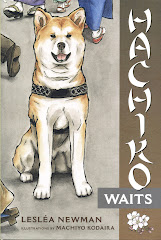
Hachiko Waits Reader Response
 This is the actual statue of Hachiko in Hachiko Plaza, Japan.
A. Hachiko Waits
B. Lesléa Newman
C. Machiyo Kodaira
D. Scholastic Inc., 2004
F. 2-4
G. Hachiko Waits is based on the true Japanese story of a dog, Hachi (later given the honorable title Hachiko), who waits for his master at the train station everyday at a little before 3 PM. He does this for a while until one day his master dies suddenly at work and does not return on the train. A young boy, who had seen Hachi and his master at the train station everyday day, decided to take Hachi in but Hachi has other plans. The first chance he gets, Hachi leaves Yasuo’s house but continues to show up at the train station everyday just before 3 o’clock. The station master and Yasuo take care of Hachi and people give donations to buy Hachi food and keep him healthy and well. For ten years Hachi waits for his master until he dies of natural causes. The town celebrates the dog’s life with a statue that everyone views as good luck. Yasuo even meets his wife there.
H. This story is a touching story of faith, devotion, and hope. Everyday Hachi comes to the train station to wait for his master who will never step off the train. I really liked this book because the theme is so universal; it goes so much further than a dog waiting on his master. Hachiko was remarkable in more ways that one. He was much smarter than any dog that I know. I don’t know any dog that is able to “tell time,” or know what time of day to show up somewhere to meet a person. He also caught on very quickly to everything that his master taught him.
Yasuo was also an impressive character. I know that the Japanese culture is very different from the American culture, but I don’t know of any boy who would be so dedicated to taking care of a dog who didn’t even live at his house. Most boys would have quit taking care of the dog as soon as he ran away (especially if there were a station master who would make sure that the dog was taken care of). Yasuo was just so impressive in the way he honored Professor Ueno’s memory by taking care of Hachi. I just loved the way Yasuo kept his promise to take care of Hachi even though I’m sure that there were several times, especially as he got older, that he would have rather been doing other things.
The support Hachi got was also touching. I can’t believe the donations that the station master got to help take care of Hachi and the number of people who came to that train station just to see and touch Hachi for good luck. I was glad to see that there was a statue put up at the station after Hachi died so that people would remember the hope and the faith that Hachi represented for so long.
I. Hachiko Waits offers a great number of ideas for lessons. This book offers a great introduction into the Japanese cultures. By reading about Professor Ueno’s and Yasuo’s habits, students can learn about how Japanese people live, and what a typical day is like for a boy in
*Multicultural*
Tuesday, April 1, 2008
Jouanah: a Hmong Cinderella
A. Jouanah
B. adapted by Jewell Reinhart Coburn and Tzexa Cherta Lee
C. Anne Sibley O'Brien
D. Shen's Books, 1996
E. Picture book, traditional literature
F. k-4
G. Jouanah is the Hmong Cinderella story. It is about a young girl whose father and mother need a cow to do work on their farm in Laos. However, they are unable to get a cow and the mother decides that she will become a cow and do the work. Selfishly, the father does not turn the mother back into a human but instead takes another wife who has a daughter about the same age as Jouanah. The new wife finds out that the cow is Jouanah's mother and this makes her very angry. In order to get rid of the cow, the new wife feigns illness and tells the father to go ask for help from the spirit of a tree. The wife disguises herself as the voice of the spirit and tells the father to kill the cow. The father kills the cow and dies soon after. The New Year festivities soon arrive. Jouanah wants to go but her stepmother makes it impossible. However, she finds a beautiful outfit in her mother's sewing basket (which has a piece of her mother's magic cowhide in it) and she is able to go to the third day of festivities. A handsome young man falls in love with her but she has to run away to get home before her stepmother and stepsister; she leaves a shoe behind. The young man ends up at their door and the shoe fits Jouanah's foot, and so they get married and move away from the stepmother. And they live happily ever after.
H. This is a beautiful version of Cinderella. All the elements of Cinderella are there but the story takes place in a world that is so very far removed from the typical Disney Cinderella that most people think of that it should almost have a category all of its own. The setting and plot elements provide a different look at what it truly means to be a Cinderella. Jouanah's mother sacrifices her own humanness to become a cow to make sure that the family is provided for. The magic that Jouanah's mother provides to ensure that Jouanah has happiness in her life is moving. I was actually quite sad when the cow died.
One thing I thought was especially interesting what how the culture was represented. While there were a lot of Hmong cultural markers in the story, I feel like the gist of the culture was somehow missed. A great deal of the Hmong culture is based on tradition and customs and propriety. When Jouanah and Shee-Nang leave her house to go to his house, that is completely taboo in Hmong culture! None of the wedding traditions were even hinted on in this book, and those traditions are actually quite interesting.
As far as Cinderella stories and children's literature go, I think this is an excellent story. However, I feel like the Hmong culture is not represented well at all in this story. I wish that the 'author' could have done a little more research into the culture so that at least the taboos weren't being shown in here as if they were everyday occurrences. I know that this is a fictional book, but I think that students will take a lot of what goes on in the book to be truth about the Hmong culture. Misrepresenting cultures only breeds problems. Not only that, but the Hmong culture is fascinating and anyone who takes any time to investigate it will be impressed and amazed at the customs and traditions of the Hmong.
I. Jouanah is another great Cinderella story to add to the collection. In addition to reading this story as a part of the Cinderella unit, it is great as an introduction to the Hmong culture. While I don't completely agree with the representation of the Hmong, it is important to get that culture group out into the mainstream because there are a lot of people who don't know about it even though there is a huge population of them living right here in our state. This book would be especially beneficial to students living in or around the Hickory area who probably see a lot of Hmong people but just think that they're Chinese or Japanese. After reading this book, it would be great to have Hmong students (if it's possible) to talk about versions of this tale that they may have heard growing up. I would have students do a venn diagram of this story versus another Hmong Cinderella story or a different cultural Cinderella if there are no Hmong students in the class. This would also be a great opportunity for students to experience Hmong music and food.
*Multicultural*
B. adapted by Jewell Reinhart Coburn and Tzexa Cherta Lee
C. Anne Sibley O'Brien
D. Shen's Books, 1996
E. Picture book, traditional literature
F. k-4
G. Jouanah is the Hmong Cinderella story. It is about a young girl whose father and mother need a cow to do work on their farm in Laos. However, they are unable to get a cow and the mother decides that she will become a cow and do the work. Selfishly, the father does not turn the mother back into a human but instead takes another wife who has a daughter about the same age as Jouanah. The new wife finds out that the cow is Jouanah's mother and this makes her very angry. In order to get rid of the cow, the new wife feigns illness and tells the father to go ask for help from the spirit of a tree. The wife disguises herself as the voice of the spirit and tells the father to kill the cow. The father kills the cow and dies soon after. The New Year festivities soon arrive. Jouanah wants to go but her stepmother makes it impossible. However, she finds a beautiful outfit in her mother's sewing basket (which has a piece of her mother's magic cowhide in it) and she is able to go to the third day of festivities. A handsome young man falls in love with her but she has to run away to get home before her stepmother and stepsister; she leaves a shoe behind. The young man ends up at their door and the shoe fits Jouanah's foot, and so they get married and move away from the stepmother. And they live happily ever after.
H. This is a beautiful version of Cinderella. All the elements of Cinderella are there but the story takes place in a world that is so very far removed from the typical Disney Cinderella that most people think of that it should almost have a category all of its own. The setting and plot elements provide a different look at what it truly means to be a Cinderella. Jouanah's mother sacrifices her own humanness to become a cow to make sure that the family is provided for. The magic that Jouanah's mother provides to ensure that Jouanah has happiness in her life is moving. I was actually quite sad when the cow died.
One thing I thought was especially interesting what how the culture was represented. While there were a lot of Hmong cultural markers in the story, I feel like the gist of the culture was somehow missed. A great deal of the Hmong culture is based on tradition and customs and propriety. When Jouanah and Shee-Nang leave her house to go to his house, that is completely taboo in Hmong culture! None of the wedding traditions were even hinted on in this book, and those traditions are actually quite interesting.
As far as Cinderella stories and children's literature go, I think this is an excellent story. However, I feel like the Hmong culture is not represented well at all in this story. I wish that the 'author' could have done a little more research into the culture so that at least the taboos weren't being shown in here as if they were everyday occurrences. I know that this is a fictional book, but I think that students will take a lot of what goes on in the book to be truth about the Hmong culture. Misrepresenting cultures only breeds problems. Not only that, but the Hmong culture is fascinating and anyone who takes any time to investigate it will be impressed and amazed at the customs and traditions of the Hmong.
I. Jouanah is another great Cinderella story to add to the collection. In addition to reading this story as a part of the Cinderella unit, it is great as an introduction to the Hmong culture. While I don't completely agree with the representation of the Hmong, it is important to get that culture group out into the mainstream because there are a lot of people who don't know about it even though there is a huge population of them living right here in our state. This book would be especially beneficial to students living in or around the Hickory area who probably see a lot of Hmong people but just think that they're Chinese or Japanese. After reading this book, it would be great to have Hmong students (if it's possible) to talk about versions of this tale that they may have heard growing up. I would have students do a venn diagram of this story versus another Hmong Cinderella story or a different cultural Cinderella if there are no Hmong students in the class. This would also be a great opportunity for students to experience Hmong music and food.
*Multicultural*
Subscribe to:
Posts (Atom)